No products in the cart.
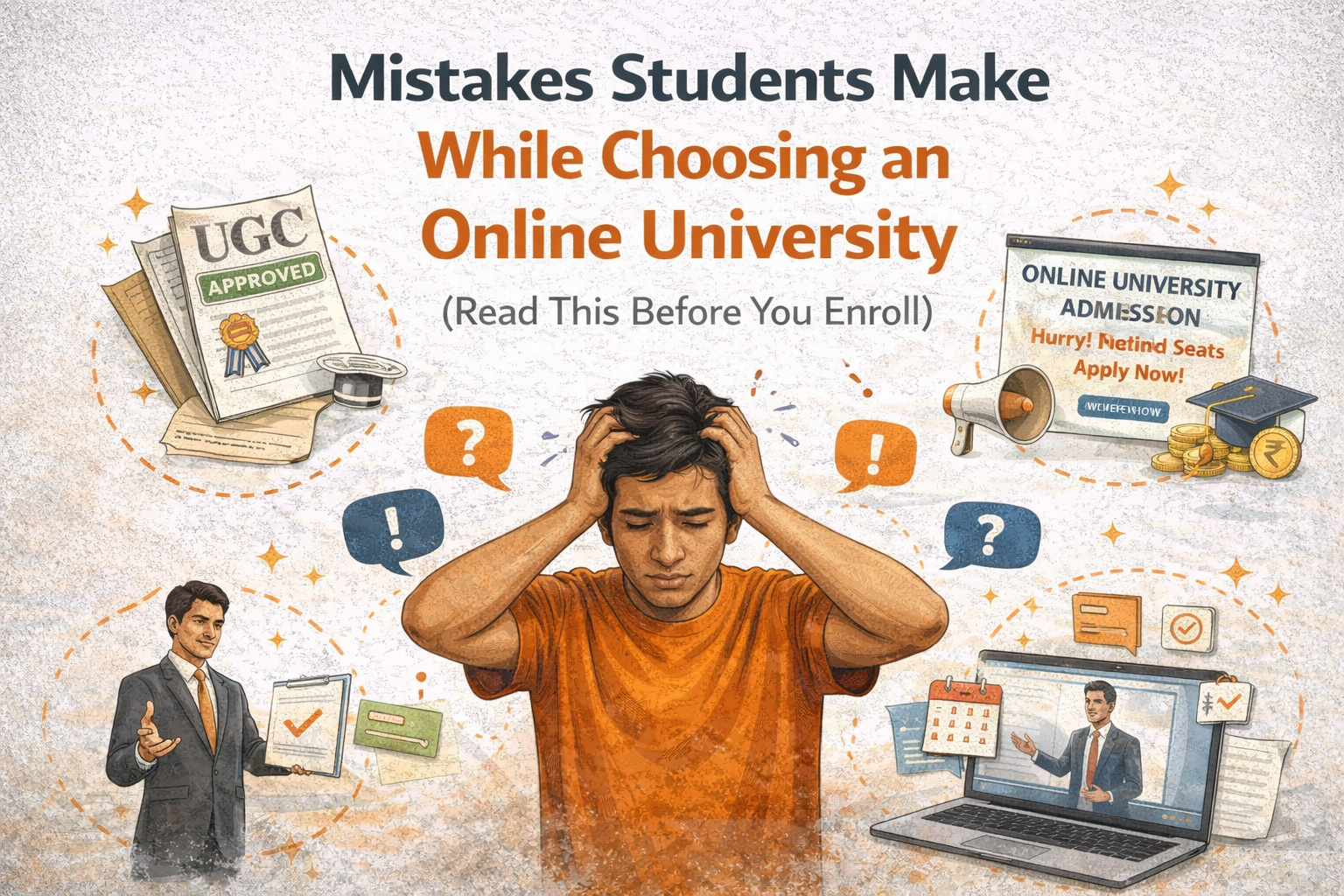
Mistakes Students Make While Choosing an Online University
Mistakes Students Make While Choosing an Online University
(Read This Before You Enroll)
Online education in India has exploded in the last few years.
Flexibility, affordability, and accessibility have made online degrees attractive to working professionals, dropouts, homemakers, and career switchers.
But here’s the uncomfortable truth:
Most students don’t fail in online education because it’s “bad”.
They fail because they choose the wrong online university for the wrong reasons.
This article breaks down the most common mistakes students make while choosing an online university, so you don’t repeat them — and don’t waste years, money, or motivation.
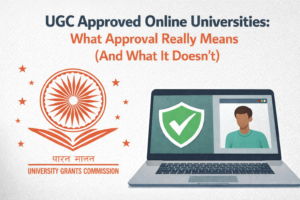
Mistake #1: Assuming “UGC Approved” Means Everything Is Safe
This is the most dangerous misconception.
Students often believe:
| “If the university is UGC approved, the online degree must be valid.”
That’s partially true — and dangerously incomplete.
What UGC approval actually means
Approval from University Grants Commission means:
- The university is legally allowed to operate
- The institution exists under Indian law
What it does NOT guarantee
- That every program is approved for online mode
- That the degree will be accepted everywhere
- That the learning quality is good
- That placement support exists
Mistake #2: Choosing an Online University Only Because It’s Cheap
Low fees attract students — understandably.
But cheap should never be the only filter.
Some universities cut costs by:
- outsourcing teaching
- using outdated content
- offering minimal student support
- overloading faculty
The result?
Students feel lost, unsupported, and eventually drop out.
Correct approach:
- Compare value, not just fees:
- faculty credentials
- LMS quality
- student support system
- exam clarity
A slightly higher fee can save you years of frustration.
Mistake #3: Ignoring Whether the Degree Matches Career Goals
Many students enroll first and think later.
Common examples:
- Choosing Online MBA without work experience
- Choosing Online BA hoping for corporate jobs
- Choosing Online MCA without coding background
Online degrees are not magic shortcuts.
Correct approach:
Ask before enrolling:
- What jobs does this degree realistically lead to?
- Is this degree for career entry, growth, or transition?
- Do employers in my field accept online degrees?
- Choosing the wrong degree is worse than choosing no degree.
Mistake #4: Believing All Online Degrees Are Equal
They are not.
Two online degrees may look identical on paper but differ massively in:
- exam rigor
- evaluation process
- employer perception
- alumni outcomes
Some universities run online programs seriously.
Others treat them as volume businesses.
Correct approach:
- Research:
- How exams are conducted
- Whether assessments are proctored
- Alumni outcomes (not marketing claims)
A degree’s value is proven after graduation, not at admission.
Mistake #5: Not Understanding the Learning Model
Online education requires self-discipline.
Yet many students enroll assuming:
- “It will be easy”
- “I can study anytime later”
- “Videos are enough”
Then reality hits.
Online programs often require:
- regular assessments
- strict deadlines
- self-paced consistency
Correct approach:
Choose online education only if:
- you can manage time independently
- you don’t need daily classroom pressure
- you’re willing to take responsibility
Online learning rewards discipline, not procrastination.
Mistake #6: Ignoring Student Support & Communication
This mistake shows up after payment.
Students realize:
- no proper helpline
- delayed responses
- unclear exam communication
- confusion during form filling
This creates anxiety, especially during exams and result cycles.
Correct approach:
Before enrolling:
- test the support team
- ask response-time questions
- check student grievance systems
If support is weak before enrollment, it won’t improve after.
Mistake #7: Trusting Agents or Advertisements Blindly
Aggressive marketing is not guidance.
Red flags include:
- pressure to enroll quickly
- guaranteed jobs
- “limited seats” urgency
- avoiding written confirmation
Correct approach:
- Verify everything independently
- Ask for official links
- Never rely only on verbal promises
If someone rushes you, they don’t have your interest in mind.
Mistake #8: Not Checking Long-Term Acceptance
Many students think only about today.
They don’t ask:
- Will this degree be valid for higher studies?
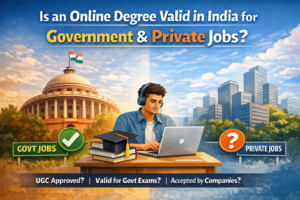
- Will it work for government exams?
- Will it be accepted outside India?
Correct approach:
Plan for 5–10 years, not just admission.
A degree should expand options, not restrict them.
Mistake #9: Assuming Online = Easy
This belief kills more online students than difficulty ever does.
Online education removes:
- daily attendance pressure
- physical supervision
It does NOT remove:
- exams
- evaluations
- deadlines
- academic responsibility
👉 Correct approach:
If you want an easy certificate, online education is the wrong place.
If you want flexibility with responsibility, it’s powerful.
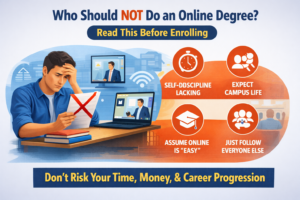
Mistake #10: Not Asking “Who Should NOT Do This?”
This question saves lives (academically).
Online education may not suit:
- students needing strict discipline
- those expecting campus exposure
- people avoiding effort
Correct approach:
Choosing online education should be a conscious decision, not a compromise.
Final Reality Check
Online education is neither a scam nor a miracle.
It is a tool.
Used correctly, it:
- saves time
- reduces cost
- enables career continuity
Used blindly, it:
- wastes money
- creates frustration
- damages confidence
The biggest mistake students make while choosing an online university
is not asking the right questions before enrolling.
If you choose carefully, online education can work for you, not against you.


Recent Comments