
No products in the cart.
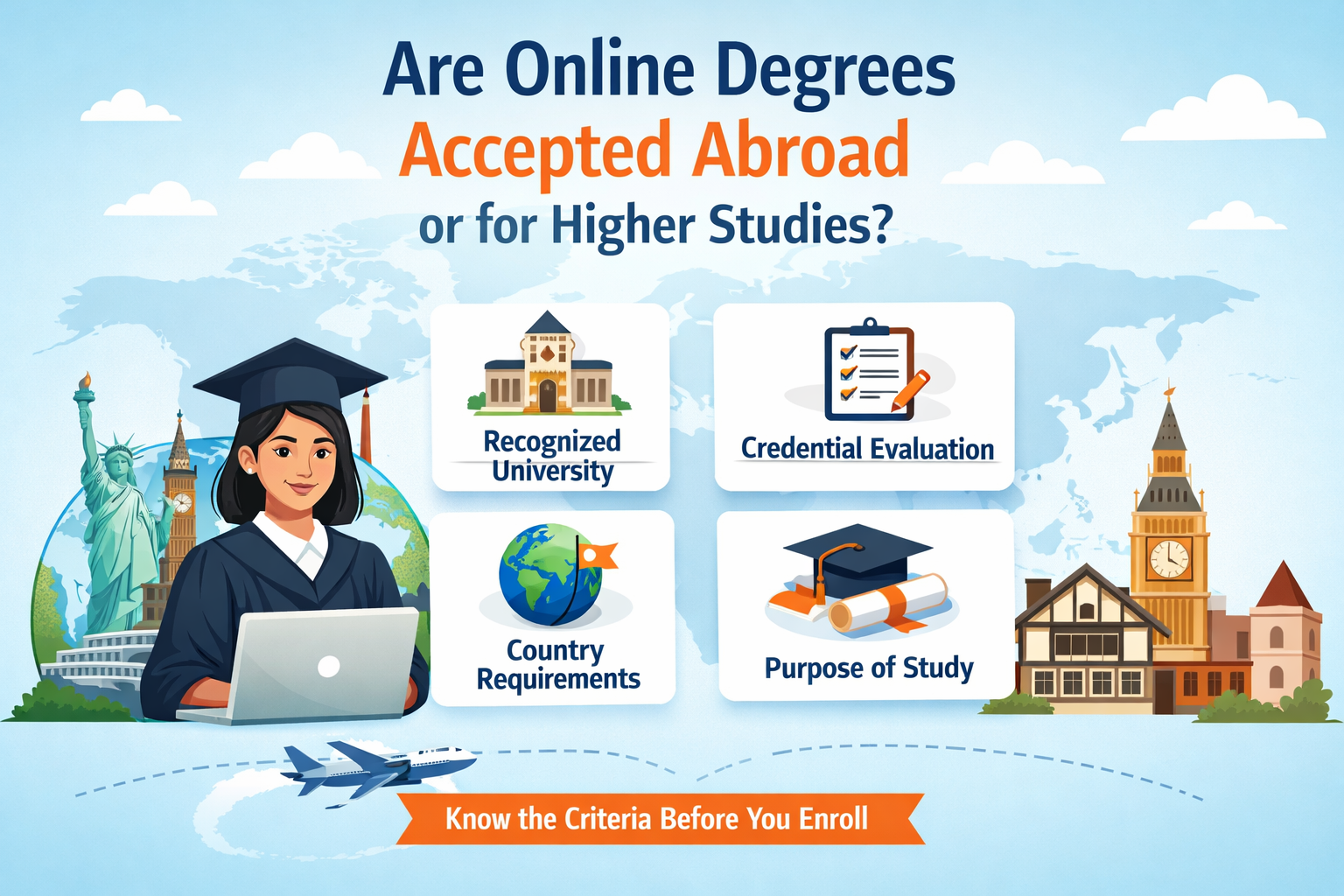
Are Online Degrees Accepted Abroad or for Higher Studies?
Are Online Degrees Accepted Abroad or for Higher Studies?
Online education has grown rapidly in India over the last few years. With this growth, many students and working professionals are now asking an important question:
Are online degrees accepted abroad or for higher studies?
The answer is yes, online degrees can be accepted internationally and for further education. However, acceptance depends on several practical factors such as university recognition, country-specific rules, and the purpose for which the degree is evaluated
This article explains how online degrees are viewed abroad, what universities and employers look for, and how students can make informed decisions before enrolling.
Understanding How Online Degrees Are Evaluated Internationally
Online degrees are not evaluated as a separate category in most countries. Instead, foreign universities and employers assess:
• Whether the awarding university is officially recognized
• Whether the degree follows a valid academic structure
• Whether the qualification is equivalent to their local education system
The mode of learning (online or on-campus) is usually secondary to these factors.
Importance of University Recognition
The most important requirement for international acceptance is that the university must be recognized in its home country.
In India, a university should be:
• Approved by the University Grants Commission
• Authorized to offer online programs through UGC-DEB
• Preferably accredited by NAAC
A degree from a recognized Indian university is considered a legitimate academic qualification, regardless of whether it was earned online or offline.
Foreign institutions do not directly check UGC approvals, but they do verify whether the university is officially recognized by the Indian government.
Acceptance of Online Degrees for Higher Studies Abroad
Can You Apply for Master’s or PG Programs Abroad with an Online Degree?
Yes, students with online bachelor’s or master’s degrees from recognized universities have successfully applied for:
• Master’s programs
• Postgraduate diplomas
• Professional and executive programs
Acceptance depends on:
• The university you are applying to
• The academic requirements of the program
• Whether your degree meets credit and duration standards
Countries That Commonly Accept Online Degrees
Online degrees from recognized Indian universities are commonly considered in countries such as:
• United States
• Canada
• United Kingdom
• Australia
• Several European countries (case-specific evaluation)
Universities focus more on academic equivalence than the study format.
Role of Credential Evaluation Agencies
In many countries, degrees are assessed by credential evaluation agencies rather than directly by universities.
A widely used evaluation body is:
• World Education Services (WES)
WES evaluates:
• University recognition status
• Degree authenticity
• Academic structure and duration
If WES or a similar agency evaluates an online degree as equivalent, it is generally accepted by universities and employers in that country.
Importantly, credential evaluation agencies do not reject degrees solely because they were earned online.
Are Online Degrees Accepted for Jobs Abroad?
For most private-sector jobs abroad, employers focus on:
• Skills and professional experience
• Relevance of the qualification
• Reputation of the university
In fields such as:
• Business and management
• Information technology
• Marketing and digital roles
• Data and analytics
Online degrees are widely accepted, especially when supported by work experience.
Situations Where Online Degrees May Have Limitations
Online degrees may face restrictions in:
• Government or public-sector jobs abroad
• Regulated professions such as medicine, law, or teaching
• Immigration pathways that require full-time, on-campus education
These limitations are usually policy-driven, not related to the credibility of online education itself.
How Foreign Universities View Online vs Regular Degrees
Foreign universities generally do not use Indian classifications such as “online,” “distance,” or “regular.” Instead, they assess:
• Whether the degree is formally awarded
• Whether the institution is recognized
• Whether the curriculum aligns with their academic standards
A well-structured online degree from a recognized university can be evaluated more favorably than a regular degree from an unrecognized institution.
Common Misunderstandings About Online Degrees
Many concerns about online degrees come from outdated or incomplete information.
• Online degrees are not automatically rejected abroad
• Regular degrees are not automatically accepted everywhere
• University recognition matters more than the learning format
• Each application is evaluated individually
Understanding these points helps students make better academic decisions.
When an Online Degree Is a Good Choice for Higher Studies Abroad
Online degrees work well for students who:
• Need flexibility due to work or personal commitments
• Choose recognized universities
• Plan to apply to universities that accept credential evaluations
• Are applying for skill-based or management programs
They may not be suitable for students aiming for:
• Highly regulated professions
• Countries with strict on-campus study requirements
What Students Should Check Before Enrolling in an Online Program
Before enrolling, students should verify:
• University recognition and approvals
• Program duration and structure
• Credit system and evaluation method
• Acceptance criteria for their target country or university
Doing this early helps avoid issues later during admissions or evaluations.
Conclusion
Online degrees are increasingly accepted abroad and for higher studies when they are earned from recognized universities and meet academic requirements. The acceptance depends on the country, institution, and purpose of evaluation rather than the mode of learning itself.
Students who research carefully and choose the right program can confidently use an online degree for international education or career opportunities.





Recent Comments