No products in the cart.
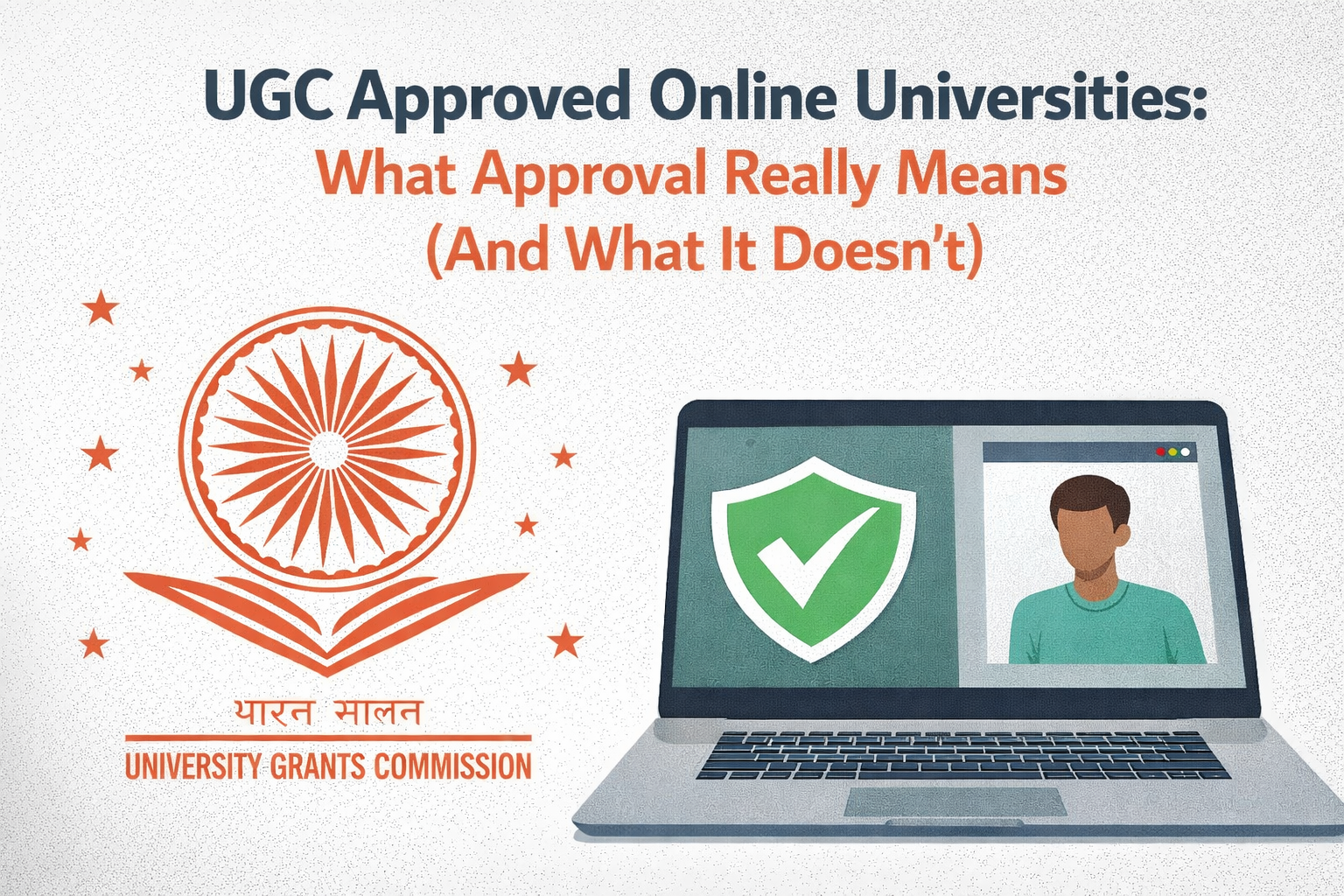
UGC Approved Online Universities: What Approval Really Means (And What It Doesn’t)
UGC Approved Online Universities: What Approval Really Means (And What It Doesn’t)
“UGC Approved Online University” is one of the most searched phrases in online education — and also one of the most misunderstood.
Students hear it and assume everything is safe, valid, and universally accepted. Education agents use it as a selling hook. Advertisements flash it without explanation. But very few people stop to ask a basic question:
What does UGC approval actually mean — and where does it stop?
If you’re planning to pursue an online degree, misunderstanding this can cost you years, money, and career opportunities. Let’s break it down clearly.
Why There Is So Much Confusion Around UGC Approval
The confusion exists because UGC approval is often presented as a single stamp of validity, when in reality it works in layers.
Most students rely on:
Ads and brochures
Agents or counselors
Social media content
Very few read official guidelines. As a result, many students believe:
If a university is UGC approved, every course is valid
If a degree is online, approval automatically applies
If something goes wrong, “UGC approved” will protect them
That belief is partially true and dangerously incomplete.
What UGC Approval Actually Means
UGC refers to the University Grants Commission, the statutory body responsible for regulating higher education in India.
When a university is UGC approved, it means:
The university is recognized under the UGC Act
It is legally allowed to offer higher education degrees
Degrees awarded by the university are valid in principle
For online education specifically, UGC approval means:
The university is permitted to offer programs in online mode
These programs must comply with UGC Online Education Regulations
Online degrees are considered equivalent to regular degrees if all rules are followed
This is the foundation of legality. Nothing more, nothing less.
What UGC Approval Does NOT Mean (This Is Critical)
UGC approval does not automatically mean:
Every course offered by the university is approved
Every online program is valid
The degree will be accepted for all government jobs
The university has high academic quality
The program is suitable for your career goals
UGC approval ensures institutional legitimacy, not universal acceptance or suitability.
This distinction is where most students go wrong.
University Approval vs Program Approval (The Biggest Gap in Understanding)
Here’s the most important clarification:
University approval = the institution is recognized
Program approval = a specific course is allowed in a specific mode
A university may be UGC approved, but:
Only certain programs may be permitted online
Some courses may be allowed only in regular mode
New programs may not yet be approved
If you don’t verify program-level approval, you’re relying on assumptions — not facts.
Online, Distance, and Regular: Approval Is Mode-Specific
Approval is not generic. It depends on how the course is delivered.
UGC regulates:
Regular (on-campus) programs
Distance learning programs
Online learning programs
A course approved in regular mode is not automatically approved online.
This is why checking:
Program name
Mode of delivery
Approval status for that specific mode
is non-negotiable.
Are UGC Approved Online Degrees Valid for Jobs?
Short answer: Yes, but with conditions.
Long answer:
Most private companies accept UGC-approved online degrees
Acceptance depends on role relevance and skills
Government jobs depend on specific recruitment rules
Some exams specify mode or institution requirements
UGC approval guarantees degree legitimacy, not guaranteed employment.
Employers still evaluate:
Skills
Experience
University reputation
Course relevance
A degree is a foundation — not a job guarantee.
Common Myths That Mislead Students
Myth 1: “UGC Approved Means 100% Safe for Everything”
False. It means legally valid, not universally suitable.
Myth 2: “Online Degrees Are Inferior”
Outdated thinking. Value depends on recognition, relevance, and execution.
Myth 3: “If One Course Is Approved, All Are”
Wrong. Approval is program-specific.
Myth 4: “Agents Will Handle Approval Checks”
Agents sell. Responsibility is still yours.
How Students End Up With Invalid or Useless Degrees
Most cases happen due to:
Not checking program-level approval
Choosing only based on low fees
Ignoring eligibility criteria
Trusting verbal assurances
The problem is not online education.
The problem is blind enrollment.
How College Sarathi Online Approaches This Differently
College Sarathi Online focuses on clarity before enrollment, not rushed admissions.
The approach includes:
Explaining what approvals actually mean
Helping students verify program legitimacy
Matching programs with career goals
Preventing costly academic mistakes
The aim is not to sell degrees, but to help students make informed decisions.
Final Reality Check
“UGC Approved” is not a magic stamp.
It’s a starting point, not the full picture.
If you understand:
What approval means
Where it applies
And where it doesn’t
you protect your time, money, and future.
Most students don’t fail academically.
They fail because they were misinformed at the start.





Recent Comments